
Disclaimer: The thermodynamic pulldown calculations, equipment comparisons, and sizing metrics provided on this page are for informational and educational purposes only. Always consult a NATE-certified professional technician before attempting any physical troubleshooting or diagnostic checks.
Homeowner Panic vs. Thermodynamic Reality
When an air conditioning system breaks down during the peak of a Williamson County summer, the indoor environment changes rapidly. Temperatures can climb past 90°F within hours, creating an uncomfortable and stressful situation for homeowners. When a NATE-certified technician from a local Round Rock AC company finally completes the repair, there is a natural expectation of immediate comfort.
This expectation often leads to homeowner panic. After the technician packs their tools, the homeowner may monitor the thermostat closely. If the temperature only drops 1 to 2 degrees after the first hour, panic sets in, leading to worries that the repair failed or that the new parts are defective. However, the physical reality of thermodynamics is very different from consumer expectations. Under typical Central Texas summer loads, a properly operating split air conditioner is designed to lower the indoor temperature at a steady rate of approximately 1°F to 2°F per hour. Expecting a house to drop from 90°F to 72°F in under an hour is physically impossible due to the sheer volume of heat energy that must be extracted from the home.
HVAC Equipment Cooling Performance Comparison
The speed at which your home cools down after an emergency AC repair service depends heavily on the technology driving your cooling system. Modern equipment behaves very differently than older legacy units during a heavy temperature pulldown under peak 95°F+ solar loads.
| Equipment Type | SEER/SEER2 Range | Pulldown Mechanics | Humidity (Latent Heat) Extraction | Coil Freeze-Up Risk Under Load |
|---|---|---|---|---|
| Modern Variable-Speed (Inverter) | 18 - 22+ SEER2 | Runs continuous, modulated cycles. Dynamically ramps up compressor speed to handle high initial thermal loads, then tapers off. | Excellent; continuous low-speed airflow keeps the coil cold, pulling maximum moisture out of the air. | Low; system monitors sensors to prevent coil freezing. |
| Standard Two-Stage Split System | 15 - 17 SEER2 | Starts in high stage (100% capacity) to handle the pulldown load, then drops to low stage (approx. 65% capacity) to maintain temp. | Moderate to High; long runtimes in low stage provide consistent moisture removal. | Low to Moderate; depends on airflow settings. |
| Legacy Single-Stage (R-410A) | 13 - 14 SEER | Operates at 100% capacity constantly. Cycles on and off. Takes longer to stabilize temperature splits. | Moderate; cycling off too quickly can leave high latent humidity in the air. | Moderate; dirty filters or restricted vents can lead to icing during extended runs. |
| Legacy Single-Stage (R-22) | 10 - 13 SEER | Runs at 100% capacity. Struggles under extreme 95°F+ loads. oboslete chemical refrigerants have lower heat transfer efficiency. | Poor; older designs focus heavily on sensible heat removal, often leaving the home feeling damp during pulldown. | High; prone to rapid freezing if refrigerant is slightly low or if airflow is restricted. |
Structural Latent Heat and Thermal Mass Retention
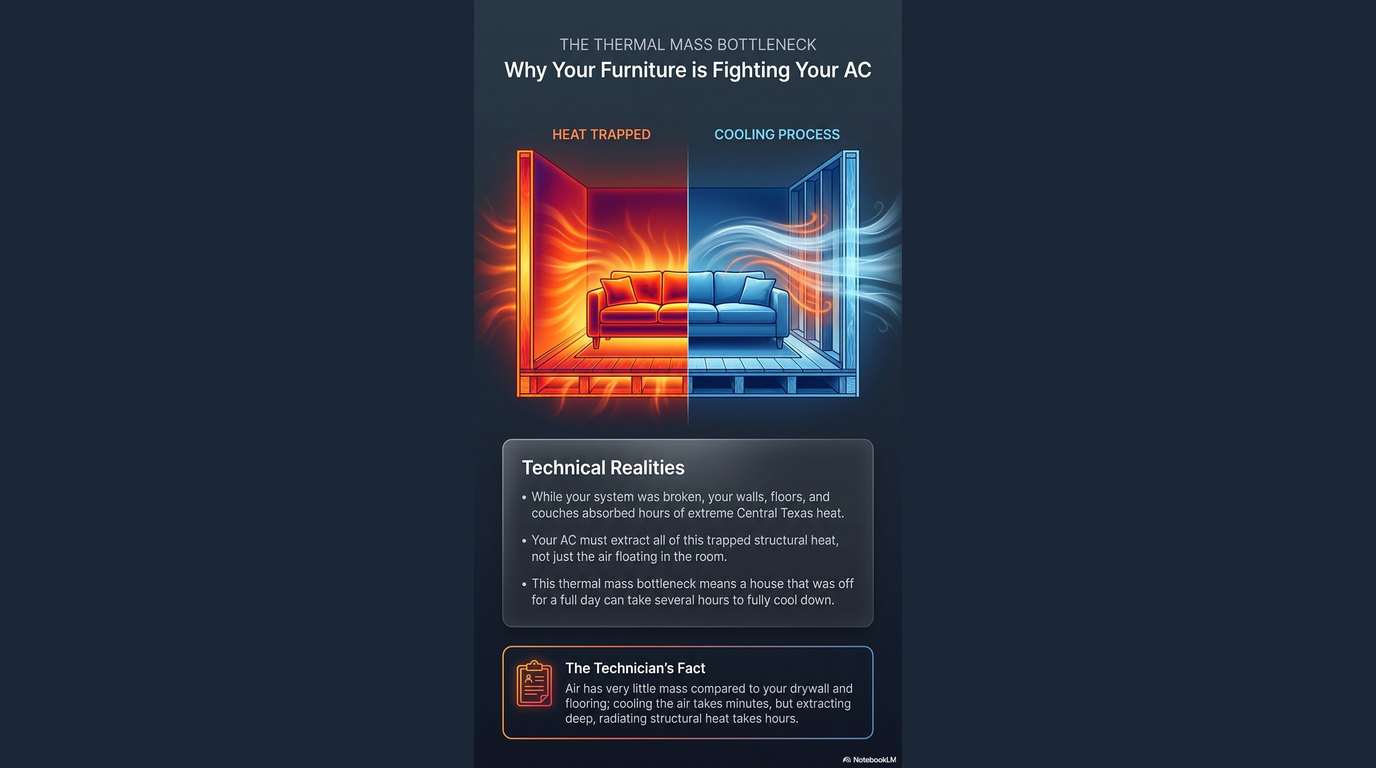
To understand why cooling takes time, we must look at the physics of heat storage. When your AC system is shut down for several hours during a heatwave near Old Settlers Park, heat does not just warm the indoor air. The air itself holds very little heat energy compared to the solid materials that make up your home.
Heat flows from the hot outdoor environment into your home's physical structure, storing energy in the **thermal mass**. This includes your drywall, wood framing, wood or tile floors, concrete slab foundation, cabinets, and furniture. A typical 2,200 sq. ft. home built between 1990 and 2015 in Round Rock zip codes like 78664 and 78681 contains over 15,000 pounds of framing timber and drywall. When the indoor temperature reaches 90°F, this massive structure absorbs and stores hundreds of thousands of BTUs (British Thermal Units) of heat energy.
When the AC is turned back on, it must extract two types of heat:
- Sensible Heat: The heat you can feel, measured by the temperature of the air. This is the heat that the thermostat registers.
- Structural Latent Heat: The heat stored inside the physical mass of the walls, framing, and floors, along with the moisture in the air.
Because the air conditioner can only extract heat from the air passing over its indoor evaporator coil, it must wait for the heat stored in the walls and framing to slowly transfer back into the indoor air. Even if the air coming out of your registers is cold, the structural thermal mass continues to radiate heat back into the rooms. The air temperature cannot reach a stable equilibrium until the system has successfully pulled all the stored BTUs out of the physical structure of your home.
ACCA Manual J/S Sizing and Sizing Principles
Many homeowners believe that if their system takes 6 hours to cool the house, the solution is to install a larger air conditioner. However, HVAC systems are engineered under strict design guidelines set by the Air Conditioning Contractors of America (ACCA):
- ACCA Manual J (Load Calculation): Calculates the heat gain of a home based on insulation, window orientation, local climate, and building materials. For Round Rock and Central Texas, the outdoor design temperature is typically 96°F to 98°F, and the indoor design temperature baseline is set at 75°F (meeting the 2012 IECC energy code requirements).
- ACCA Manual S (Equipment Selection): Specifies that the cooling system must be selected to match the Manual J load calculation, preventing both under-sizing and over-sizing.
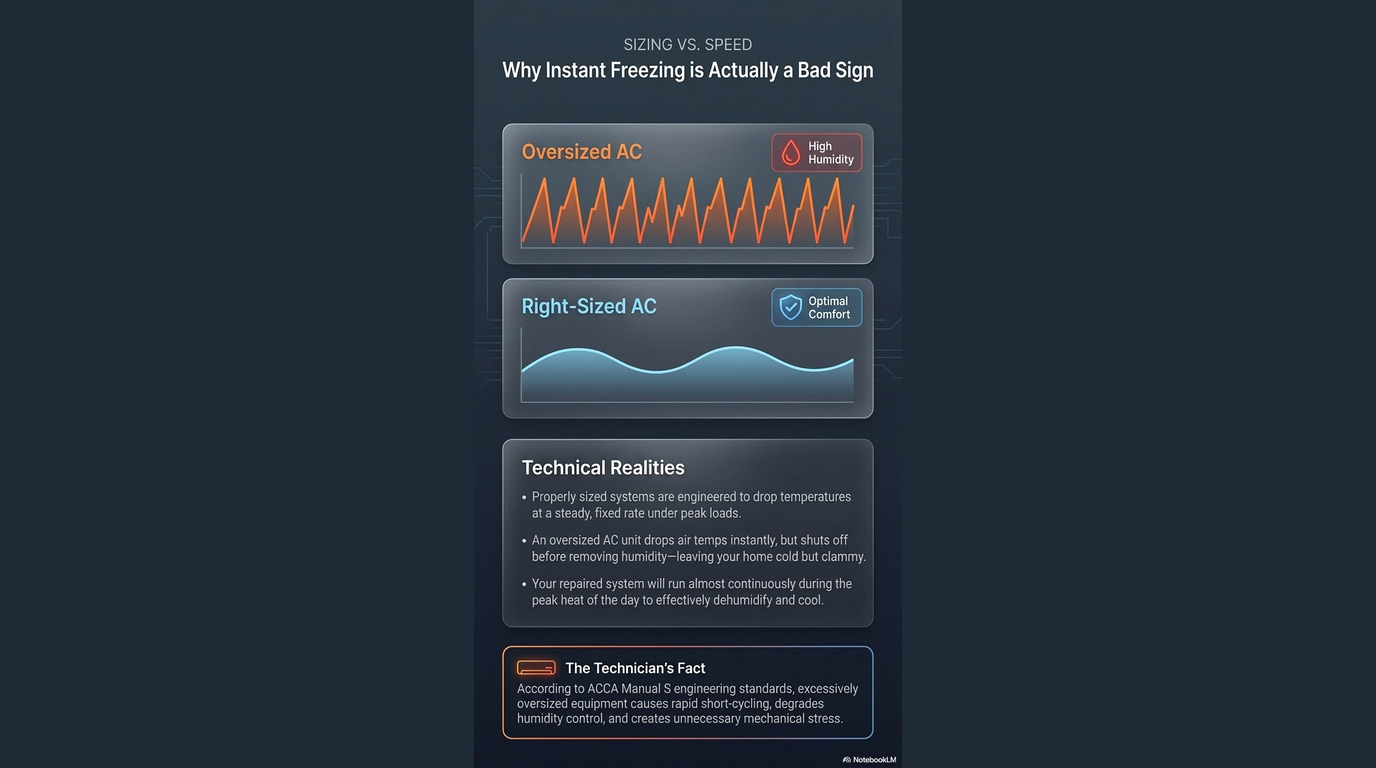
An HVAC system sized correctly under Manual J and S is designed to maintain 75°F indoors when the outdoor temperature reaches 96°F. It is **not** designed with excess horsepower to quickly pull down a hot house. Sizing a system exactly to these standards is critical for operational efficiency. If a system is oversized to achieve faster cooling recovery times, it introduces major mechanical and comfort issues. An oversized AC will cycle off too quickly (short-cycling) because it satisfies the thermostat's sensible temperature setting before it has run long enough to pull latent moisture out of the air. This results in a home that feels cold but damp and clammy, leading to high indoor humidity, poor air circulation, and accelerated wear on the compressor.
Delta T (Temperature Split) Validation Protocol
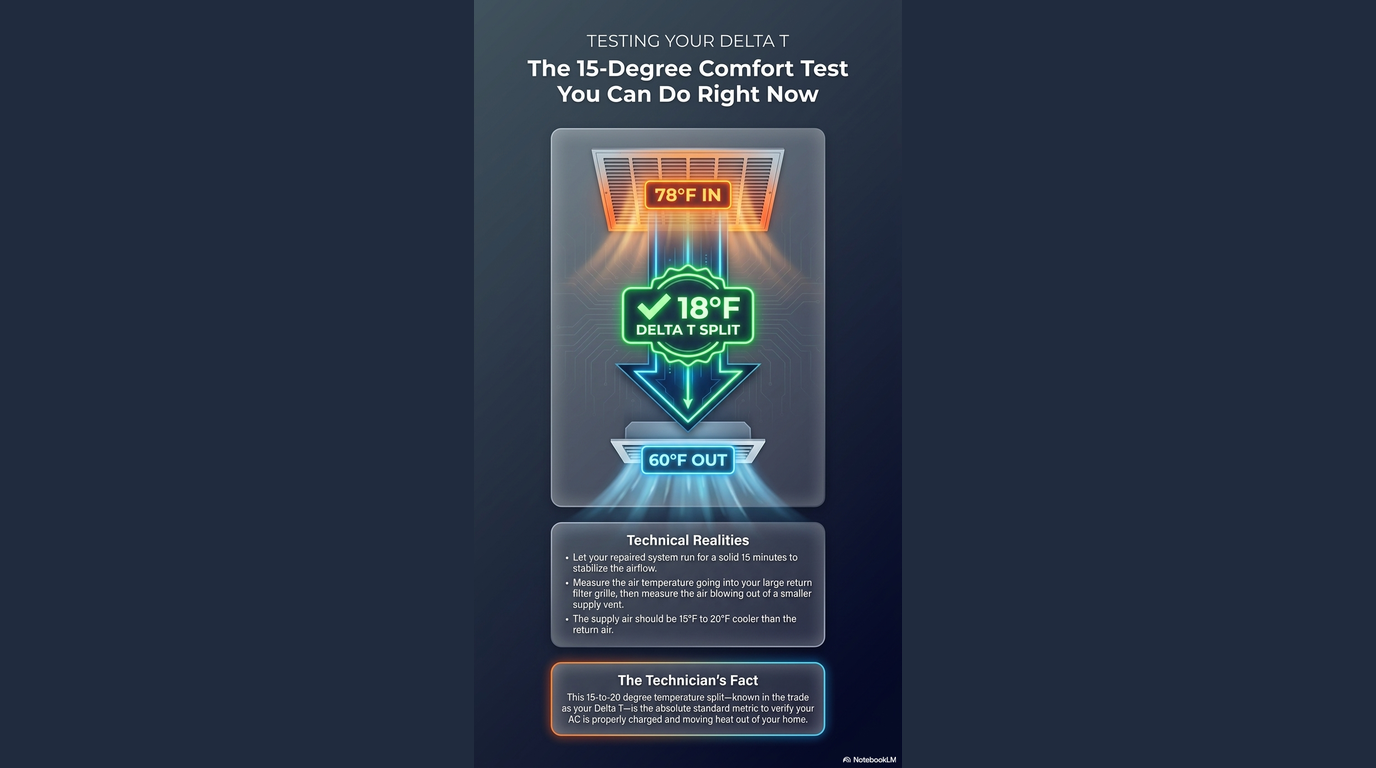
If you have recently had a repair completed in a neighborhood like Teravista or near the Historic Downtown area, you can easily verify if your system is operating at peak thermodynamic efficiency yourself. The **Delta T (Temperature Split)** measures the difference in temperature between the air entering the system and the air leaving it. A properly operating system should exhibit a split of **15°F to 20°F**.
Follow this step-by-step protocol to validate your system's performance:
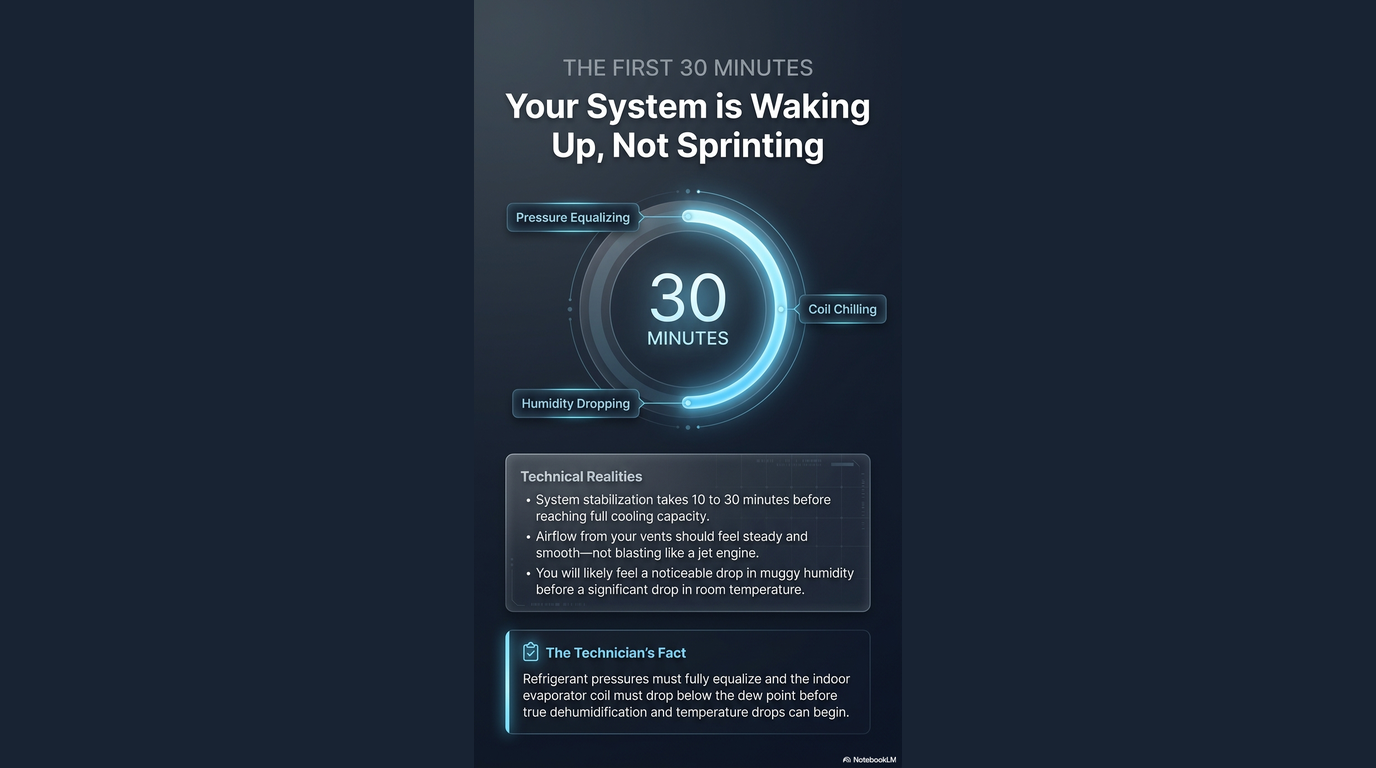
- Let the System Stabilize: Ensure the air conditioner has run continuously for at least 15 to 20 minutes. This allows refrigerant pressures to equalize and the indoor coil to reach its design operating temperature.
- Use the Right Tool: Use a digital probe thermometer. Do **not** use an infrared laser thermometer, as laser guns measure the surface temperature of the grille, not the temperature of the moving air.
- Measure the Return Air: Insert the thermometer probe into the center of your return air grille (where the air filter is located). Note the entering air temperature (e.g., 78°F).
- Measure the Supply Air: Move to the supply register closest to the indoor unit (to minimize duct heat gain). Insert the thermometer probe into the vent louvers. Note the leaving air temperature (e.g., 60°F).
- Calculate the Split: Subtract the supply air temperature from the return air temperature.
Example: 78°F (Return) - 60°F (Supply) = 18°F Split.
If your split is within the 15°F to 20°F range, your system is extracting heat correctly. The thermostat will eventually drop as it draws the stored BTUs out of your home's thermal mass. If the split is **below 15°F**, the system is not cooling efficiently (possibly due to low refrigerant, a failing compressor, or duct leaks). If the split is **above 20°F**, it indicates restricted airflow (such as a severely clogged air filter or undersized ducts), which can cause the evaporator coil to freeze.
If your system is not maintaining a proper split, or if the temperature has not dropped after several hours of operation, contact our team for reliable diagnostics. We serve homeowners throughout the local area, including communities near Brushy Creek, providing fast, professional solutions to restore your comfort.