
In the peak of a Williamson County summer, a fractured air conditioning system is more than an inconvenience—it is a failure of critical safety infrastructure. When the heat index spikes in neighborhoods like Teravista or Brushy Creek, indoor temperatures can reach dangerous levels within hours, posing significant risks to seniors and children. As a Master HVAC Architect, I can tell you that the urgency of the Texas sun must be balanced with NATE-certified diagnostic precision. Rushing a technician often leads to "part-swapping" rather than true problem-solving. To ensure your home is restored to a safe, sustainable climate, you need a local Round Rock AC company that respects both the clock and the mechanical rigor required for a lasting fix.
The following data serves as the baseline for establishing professional expectations before your technician arrives on-site.
Disclaimer: The diagnostic matrix, chemical refrigerant guidelines, and cooling recovery timelines provided on this page are for informational and educational purposes only. HVAC diagnostics and repairs involve high-voltage electrical circuits and pressurized gases, which present serious safety hazards. Always consult a NATE-certified professional technician before attempting any physical inspections, diagnostics, or repairs on your home's cooling infrastructure.

The Professional HVAC Repair & Diagnostic Timeframe Matrix
Strategic repair timelines are not arbitrary; they are dictated by the physical constraints of specialized tools and mandatory safety protocols. Diagnostic meters and thermal imaging sensors require specific "soak times" to provide accurate electrical and refrigerant data. In our local climate, skipping these windows leads to the "callback" epidemic that plagues lesser service providers.
| Service Task | True Mechanical Process | Minimum Time | Maximum Time / Complication Variables |
|---|---|---|---|
| Diagnostic | Comprehensive electrical, airflow, and refrigerant cycle analysis. | 30 Minutes | 60+ Minutes; complex or intermittent electrical faults. |
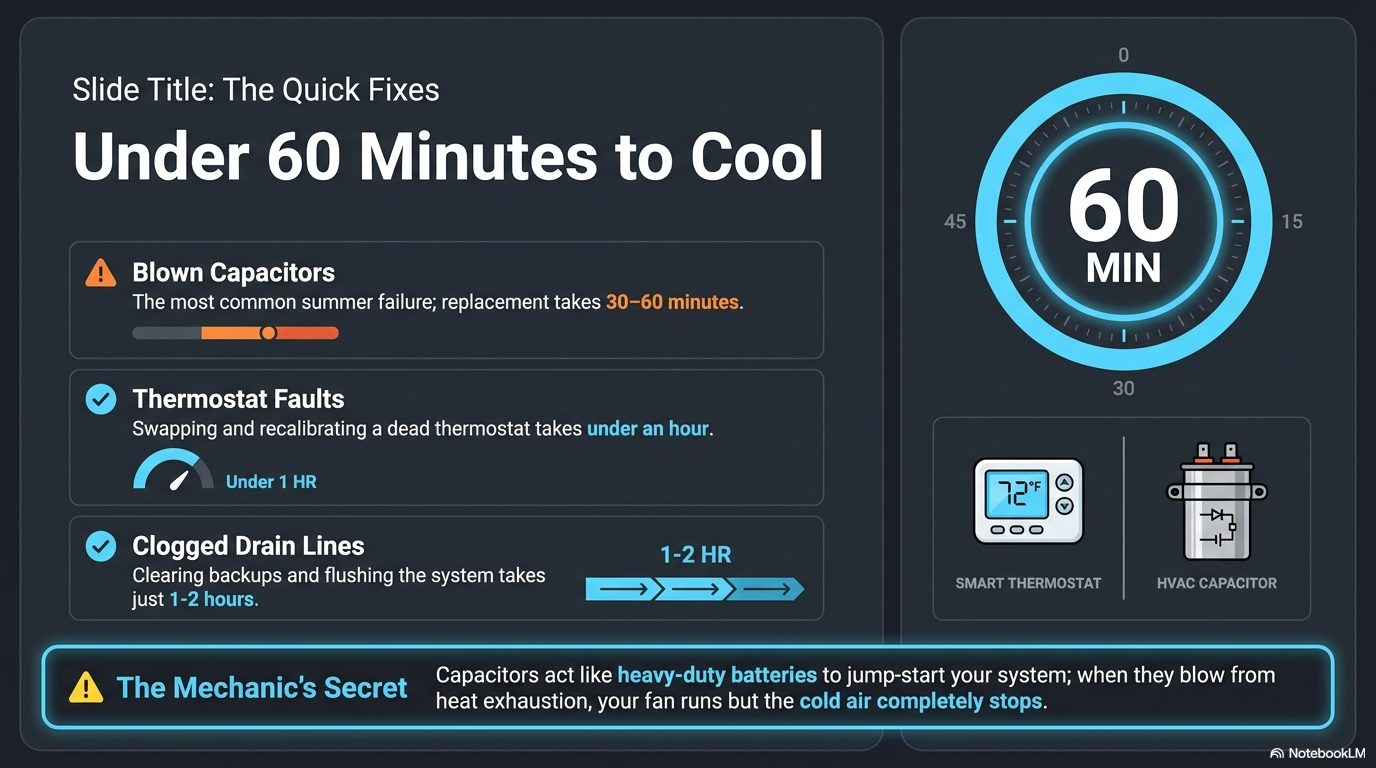
| Blown Capacitor | Discharging, testing, and replacing the start/run capacitor. | 30 Minutes | 60 Minutes; accessibility of the service panel or wiring damage. |
| Thermostat Swap | Removal, wiring, and digital interface recalibration. Supports ductless mini-split troubleshooting. | Under 1 Hour | 1.5+ Hours; installation of a C-wire (Common Wire) or power extender kit. |
| Frozen Coils | System de-icing, airflow verification, and blower inspection. | 2 Hours | 6+ Hours; depends on ice thickness and root cause. |
| Clogged Drain Line | Flushing the primary/secondary lines and clearing the P-trap. | 1 Hour | 2 Hours; requires testing of the float switch and safety pans. |
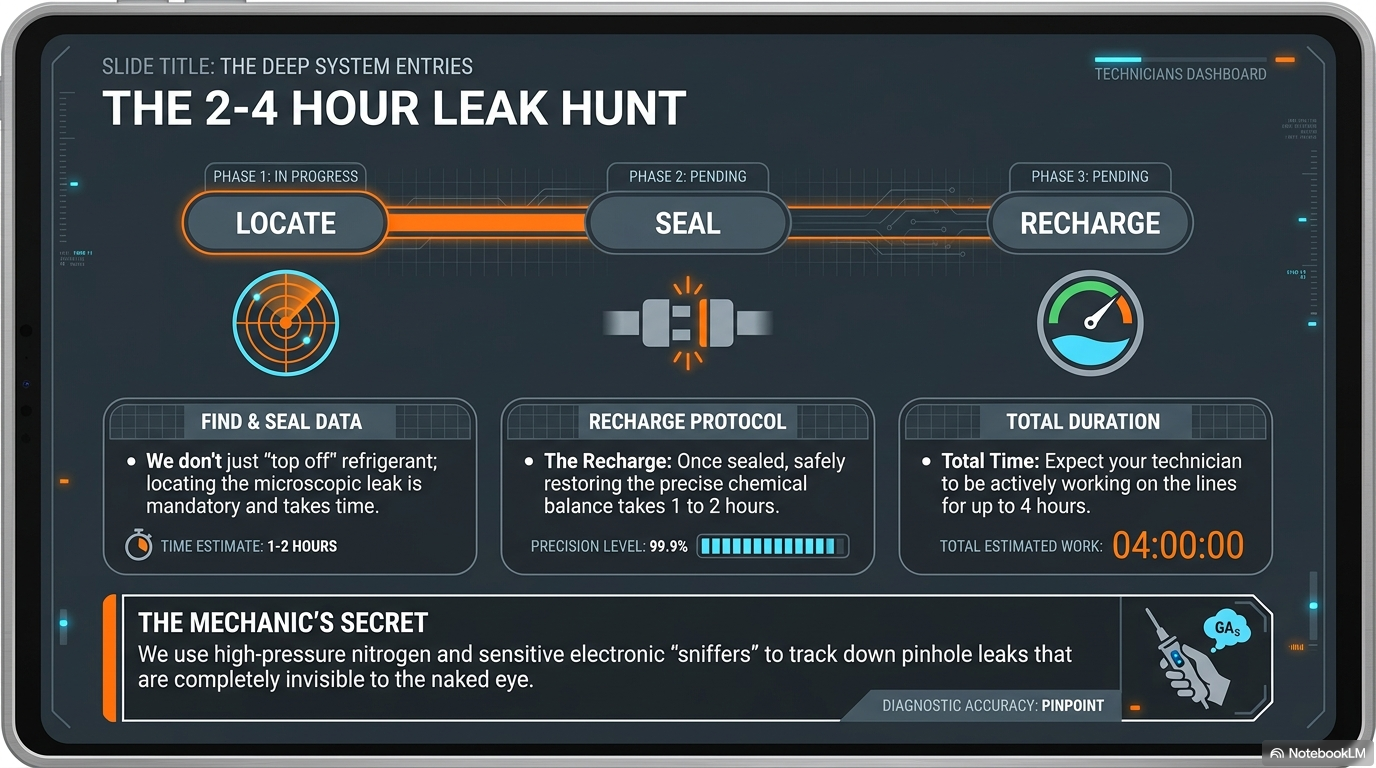
| Leak Fix & Recharge | Electronic leak detection, sealing, and recharging to factory specs. | 2 Hours | 4+ Hours; complexity increases with the number of micro-leaks. |
| Blower Motor | Pulling the blower assembly and swapping the motor/capacitor. | 1 Hour | 2 Hours; heavily influenced by attic vs. closet accessibility. |
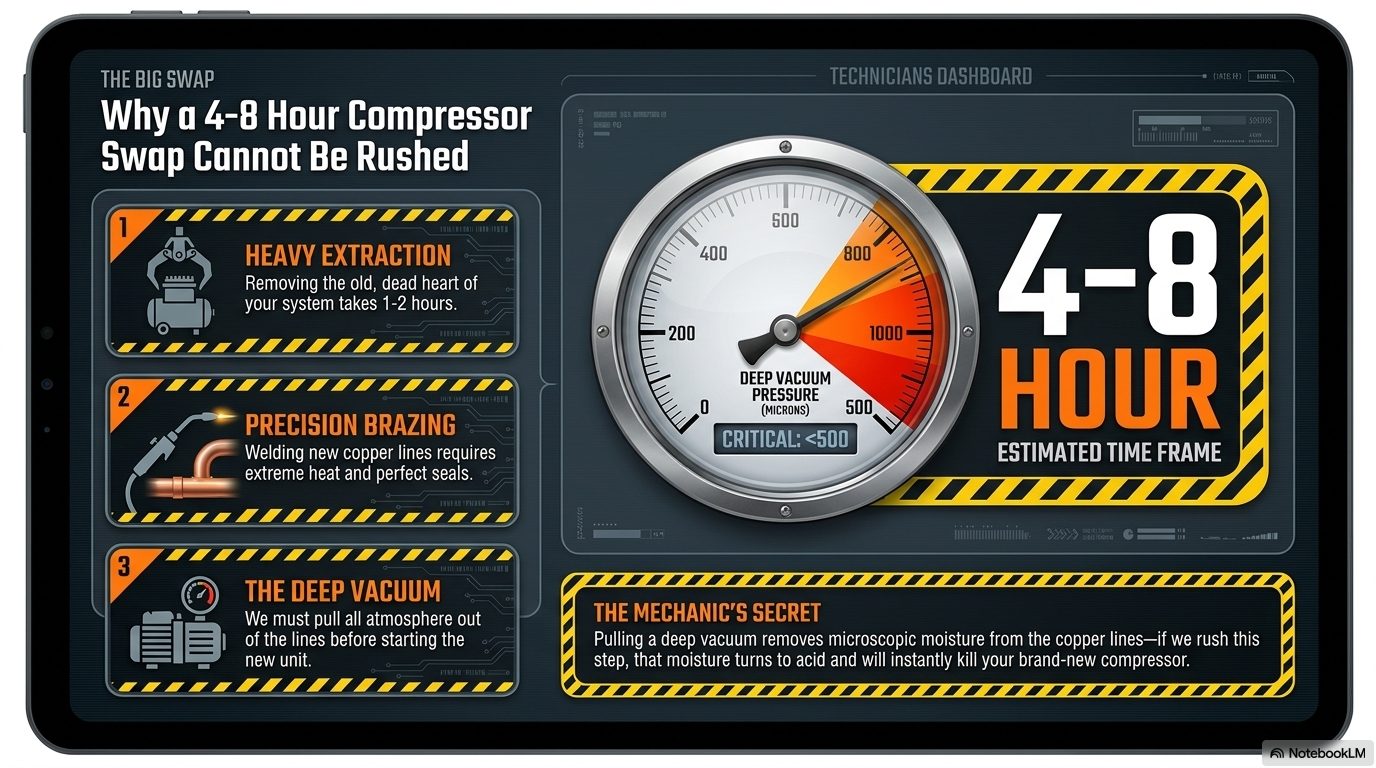
| Compressor Swap | Full sealed system entry, component replacement, and deep vacuum. | 4 Hours | 8+ Hours; often a multi-day ordeal involving warranty sourcing. |
While these windows represent standard mechanical operations, any "sealed system" repair is governed by the unyielding laws of physics, particularly regarding atmospheric contamination.
Why a Proper Sealed System Entry Requires a Fixed Physical Clock
Entering the refrigerant lines—the "Sealed System"—is the highest-stakes phase of AC repair. Because the compressor is the heart of your infrastructure, even microscopic amounts of moisture reacting with refrigerant oil creates acid that will eat the motor windings from the inside out. A professional repair follows a non-negotiable physical timeline:
- Mandatory Recovery: All remaining refrigerant must be legally recovered into specialized tanks. This is a volume-based process that cannot be accelerated.
- Oxygen-Free Nitrogen Testing: We pressurize the system with dry nitrogen to find micro-leaks. Using nitrogen creates an "oxygen-free" environment, which is vital to prevent internal oxidation and copper scaling during the brazing process.
- The "Deep Vacuum" Process: This is the primary bottleneck. A vacuum pump must draw the system below 500 microns. This is physically necessary to "boil off" moisture at room temperature. If a tech claims to be done with a vacuum in 15 minutes, they are setting your system up for premature failure.
- Charging by Weight: We do not "charge by feel." A NATE-certified professional uses a digital scale to charge the system to the manufacturer’s exact ounce specifications, ensuring the unit operates at its designed SEER efficiency.
Sourcing Lead Times and Equipment Age in Round Rock
Round Rock’s neighborhood development history directly impacts how long your repair will take. The housing stock in zip codes like 78664 and 78681—particularly the established homes near the Historic Downtown area and Chisholm Trail Crossing Park—often features systems reaching the 12-to-15-year mark.
For these residents, parts availability is the primary complication. Many older systems in these zip codes still rely on discontinued control boards. Sourcing obsolete components from regional Central Texas distributors can transform a 2-hour mechanical fix into a 48-hour sourcing delay. If the repair cost for these aging units exceeds 50% of a new system's value, we shift the conversation to replacement to protect your long-term energy budget.
Thermal Reality: The True "Cool Down" Estimation Window
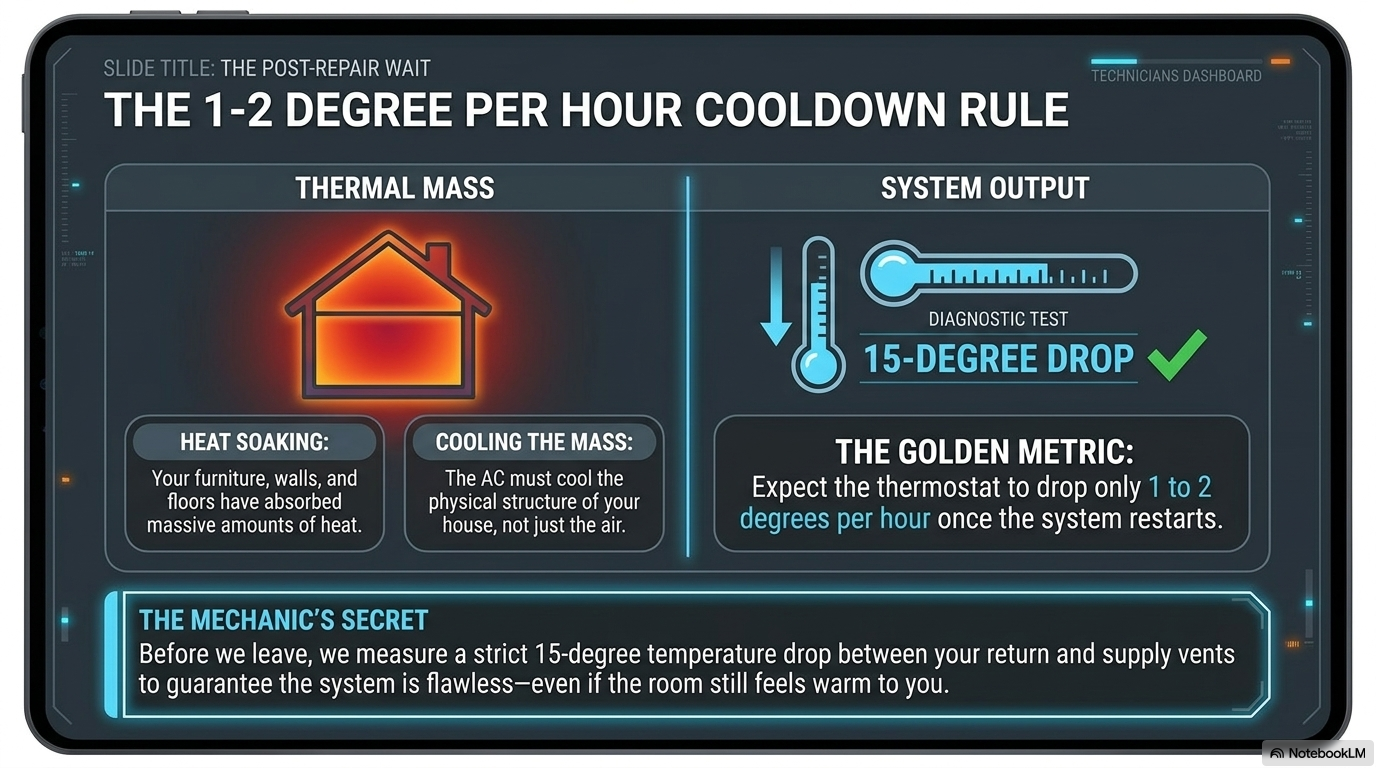
Homeowners often expect an instant drop to 72°F the moment the technician packs their tools. However, mechanical completion is not the same as home comfort. A residential split system is designed to extract heat gradually, not instantly.
In our local climate, a properly functioning system typically only drops the indoor ambient temperature by 1 to 2 degrees per hour. If your home reached 88°F during a breakdown near Old Settlers Park, it may take 8 to 10 hours to reach your desired setpoint. You can verify the success of the repair yourself by checking the "Temperature Split" (Delta T): the air coming out of your supply registers should be 15 to 20 degrees colder than the air entering your return vent. If the split is less than 15 degrees, the heat extraction process is failing.
Protecting Your Home Comfort Infrastructure
The best way to avoid the stress of a mid-summer mechanical timeline is proactive infrastructure management. Regular seasonal tune-ups, especially for homes near high-pollen areas like Old Settlers Park, prevent the emergency scenarios described above by catching failing capacitors or clogged drain lines before they cause a total system shutdown. Proactive maintenance prevents "short-cycling," where the system turns on and off rapidly, leading to the most expensive repair in the industry: a burnt-out compressor.
If your system has failed or isn't maintaining a 15-degree split, do not wait for the indoor temperature to become a health hazard. Contact our emergency AC repair service for a professional diagnostic and a transparent restoration timeline.